Grain Drying
Dryer Master Experiences: Jon in Ontario
Jon is relatively new to Dryer Master but he is great example of how moisture control is no longer just for big elevators, and how more and more it is making its way into smaller operations.
Jon has a DM510 system and has had it for 2 seasons now. He added it as a retrofit onto an MC dryer and dries about 300,000 bushels a year of corn and soybeans.
Why did you buy a Dryer Master in the first place?
We had been having issues with the original controller, the dryer had to be babysat 24/7. With just myself looking after the elevator during harvest it became very necessary to find a controller that I could trust so that I could get some sleep and be functional the next day.
How does the Dryer Master change the way that you dry, or help your drying operations from an operational perspective?
It has given me a lot more confidence in my drying system which allows me focus on other parts of the system which need my attention during the course of the day. Once its up and running I check the calibration once in the morning and once more before I head to the house for the night. With the Dryer Master running I just don’t stress about my dryer anymore.
Did anything surprise you about how your Dryer Master worked when you first used it?
I thought it would be more complicated to run than it is. I was completely comfortable running the system within just a couple of hours. The over the phone support is great, everybody at Dryer Master seems to know the system like the back of their hand.
What drying tips (if any) would you like to pass on to other dryer owners about how to get the most out of their dryer and/or their Dryer Master?
Give the system time to react if you make changes to the settings. 1-1.5 hours depending on how fast the dryer is running. Too many changes in a short period of time will have you frustrated and chasing your tail. Once the Dryer Master is up and running it takes very little interaction to keep it going. Let it work and find something else to fuss over.
Have you found a financial difference in your drying performance using Dryer Master? In what way?
The biggest financial gain for us would be the accuracy that it can discharge grain at the correct moisture. We have noticed that when shipping grain out, our bins are much more even top to bottom, with no wild swings in moisture. Over and under drying used to cost us every year, now its pretty much a non issue.
Do you use DM Mobile? If so how do you use it (phone/PC/home/at night?)
Yes, definitely. This is a huge benefit to my operation. I use it throughout the day from my Iphone, and also at night from my Ipad or Iphone. I can wake up a couple times through the night, see whats happening and get back to sleep. It has made the harvest season mush easier to get through. My days run much smoother because I’m not completely exhausted from being up all night with the dryer.
Dryer Master Experiences: Myron in Illinois
Myron has worked with Dryer Masters systems for over 10 years. He currently uses two DM510s on two Zimmerman 4500 tower dryers, typically drying around 4 million bushels of corn a year. In the first photo you have the DM510’s sitting side by side, along with the printers that Myron makes good use of. The bottom picture shows a slightly unusual sensor placement (the conduit runs to the back of the moisture sensor).


How does the Dryer Master change the way that you dry, or help your drying operations from an operational perspective?
We can generate a printout tape to evaluate the functions over night or during the day. To monitor moisture ranges.
Did anything surprise you about how your Dryer Master worked when you first used it?
The ease of operation.
What drying tips (if any) would you like to pass on to other dryer owners about how to get the most out of their dryer and/or their Dryer Master?
During start up – give it plenty of time to learn and if possible they work the best if you don’t shut down, and run 24 – 7.
Have you f ound a financial difference in your drying performance using Dryer Master?
Yes, more consistent for moisture blending.
Winter drying in China
As we start the New Year in North America grain drying has, for the most part, been done for some time now. Such is not the case in parts of China.
In North East China (for example in provinces like Heilongjiang, Jilin, Inner Mongolia and Liaoning) the drying season for corn (using grain dryers as opposed to sun drying) can extend for 4 months or even longer, from November through to March. On a recent visit to China in early December, after almost all of our North American customers had finished drying, we found many of our customers in China just getting started.
This is because in these northern areas the cold weather arrives early and so corn can be harvested and stored for some time before it has to be dried. The grain storage depots take advantage of this by extending their drying season and then using their grain dryers over an extended period. It is an efficient use of the dryers, even if the weather outside does make drying a bit more of a challenge.
Of course this means that corn is often being dried when the outside air temperature is well below freezing and the corn coming into the dryer may in fact be frozen. Measuring the moisture of frozen kernels is an interesting problem, but one that Dryer Master in-line moisture sensors are ready to meet.
Another challenge faced when drying grain in China is that unlike North America where NG or propane may be used as a fuel and a constant drying air temperature is expected, in China coal is used for much of the drying. With a coal fired system it is far more difficult to achieve a steady drying air temperature and in fact you will see quite a variation in the drying temperature. It is no surprise then that the tending of the coal fire becomes one of the more important jobs at the depot site.
As in other parts of the economy the Chinese government has made a major push to improve the quantity and quality of the countr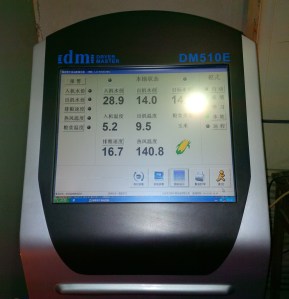 y’s grain handling infrastructure. There has been a significant expansion of the number of the grain handling depots and their storage capabilities as well as an investment in new technology. In addition to the many storage depots that are managed by state owned enterprises, there is also an increasing number of privately run storage depots as well.
Wherever we went, even in more remote areas, the construction cranes were everywhere. It is no exaggeration to say that the scale of the advancement and improvement in infrastructure, both in agriculture and generally in the economy, is mind-boggling.
What’s your “Dead Time”?
Imagine you are at your dryer and you have just taken a moisture sample.
The corn tests at 14.2% in your bench top, but you want 15.2% coming out of the dryer. What do you do?
Let’s say you decide to increase the metering roll speed (discharge rate). You make the change, but right away two thoughts strike you. First did you make a big enough change, or maybe too big of a change, and second, just how long will it be until you know the answer to your first question.
Just like there is a lag between when you turn on the shower and when you actually get hot water there is a lag between when you make a change to the metering roll speed and when you see the impact of that change. This is what is called “dead time”.
If your dryer has a cooling zone, then the absolute minimum dead time before you see any change in your outlet moisture is the time it takes for the grain to get from the bottom of the hot zone to where you take your moisture sample. This is because the grain that was already in the cooling zone will not see any change in moisture because of your rate change. In reality though you should be looking at up to a full dryer load before you see the full impact of your change. Only then can you know if you made the right change.
So, if your dryer has only a 60 minute residence time and a cooling zone, you are probably still looking at about 50 minutes to see if the rate change was correct. If you have a rack style dryer with say a 3 hour residence time then you could be looking at well over 2 hours to see the impact of your change.

Let’s use as an example the sample dryer at the right with a 3 hour residence time – 2 1/2 hours in the hot zone and 1/2 an hour in the cooling zone. If you make a discharge rate change the grain in the cooling zone will not be impacted by the change. The final moisture of this grain has already been set at this point. The grain in the bottom half of the hot zone is also unlikely to see the full impact of the change. Again in our example, by the end of the hot zone if the grain is over dried it can not be undried at this point. Therefore it is likely that to see an impact from the rate change the grain will have to at least be in the top half of the hot zone. That means you would have to wait at least 2 hours for it to exit the dryer before you might start to know if your rate change decision was correct. That’s why it is called “dead time” – time you have to wait not knowing if the right decision was made, and it is one of the reasons grain drying is so tough.
It is no wonder that so many dryer operators prefer not to make too many rate changes, and prefer to err on the side of caution (over drying a bit). If they make the wrong decision it can take up to a dryer load to get things back in order.
In our next post we will look at how Dryer Master handles the “dead time” problem to help users take the guesswork out of drying their grain.
DM-Mobile from Dryer Master: Adding mobility and peace of mind to your drying season.
 DM-Mobile brings true real time remote moisture monitoring and drying control to the grain industry.
Now your moisture and drying information can be easily accessed through your web browser on your smart phone, tablet or PC. There is no app to run. Just open your browser and go to my.dryermaster.com and log in to your Dryer Master DM510*
With DM-Mobile you can view real time moisture and drying information (including alarms) as well as up to 24 hours of historical data. You can also even make changes to moisture and rate set points all directly from your browser. Now you no longer always have to be close to the dryer to know what’s going on.
Why not try out DM-Mobile at my.dryermaster.com (log in: demo, password: demo). If you are not yet familiar with the DM510 you might want to take a minute to read the help page for a quick run down of DM-Mobile’s features.
To help promote this valuable new feature Dryer Master is adding DM-Mobile as a standard component to its industry leading DM510 computerized drying control systems at no additional charge for 2014.
If you would like to learn more about the DM510 and how it can add profits and peace of mind to your next drying season why not check out our product page on our web site or one of our DM510 training videos on our YouTube channel, or even better give us a call at 1-888-318-0009 (toll free in North America) or at 1-519-725-4700.
* requires connection of DM510 to an internet enabled router
How “Representative” is Your Moisture Sample?
Taking a moisture sample when you are drying may seem like an easy process, and in some ways, it is. But it can also give you a false sense of having a very precise result.
Take the case of when you go to the dryer and take a grab sample. You take the sample back to the bench top tester and get a digital readout. Let us say this time the readout is 15.2 percent… So, what does this number mean?
It does not mean that all the grain coming out of the dryer is at 15.2 percent. One way to easily see this is to watch the continuous readout from the Dryer Master, which can move up and down a few tenths of a point over a few minutes.
Another way to see this is to take three samples three or four minutes apart and see if the three samples give you the same reading. In most cases, they will not be exactly the same. The questions begin: Which one is right, and which one should you be using to make any adjustments to your drying?
Small differences are actually a very normal part of sampling. It is all but impossible to get an exact reading that covers all the grain exiting the dryer. There is simply too much inherent variation. This also explains why you may see small differences with your readings and the Dryer Master readings when you are doing calibrations.
That brings us to one of the benefits of Dryer Master. The DM510 continually (6 times a second) samples the grain moisture at the outlet of the dryer, and at the inlet too, so you always have a good idea of the moisture levels going into and coming out of the dryer. The Dryer Master is also aware of these variations and takes them into account when making its control (discharge rate) adjustments.
Maximizing Drying Efficiency
 One of the things that makes grain drying a challenge is the number of uncontrollable variables—such as different moistures, temperatures, wind speeds, and humidities. But there are a few things you may have some control over (at least some of the time) that can make your drying more efficient. In this post we are going to highlight two of them:
Longer dryer runs. The trend to larger dryers has meant that in some cases there is only enough product for short runs, so the dryer may only run for a couple of hours, then be turned off for a few hours. The problem is that the grain that is left in the dryer during the shutdown will tend to come out over dried. And of course, the more often there are shutdowns the more grain will come out over dried. Ideally, the goal should be to try for longer dryer runs when possible because a dryer is most efficient when running continuously at capacity.
Tempering. Many times on the graphs we download from our customers, we can see the clear difference in moisture variation between day time and night time operation.
During the day, incoming product may go straight into the dryer, but as the product is coming from different locations, the moisture may vary significantly from one truck load to the next. This variation in moisture makes drying to a constant target that much more of a challenge.
In contrast, the product being dried at night may have sat for a few hours in storage having some time to temper—or an opportunity to mix with other product. The result is more consistent moisture going into the dryer and an easier process to control.
Maintaining Dryer Efficiency: Part Two
 In the last blog post, we talked about how the buildup of fines and red dog can reduce dryer capacity for screen dryers. In this post, we want to continue the discussion and look for a way to tell if you are losing capacity.
Here is the most obvious way to see if you are losing capacity: You will see the moisture leaving the dryer increasing over time, requiring you to reduce the discharge speed to achieve the desired moisture target (the grain has to stay in the dryer longer for the same inlet moisture). The normal temptation here would be to increase the temperature to get the rate back up again, but this could have implications for quality.
For example, at the beginning of the week let’s say the average discharge rate was 30, and at the end of the week, the discharge rate has fallen to 24 because of buildup. This results in a 20 percent loss in throughput.
The reduction in capacity can also have an impact on electrical consumption—as you could see higher electrical usage from increased power usage by the fans, due to higher back pressure. This can negatively affect product quality as well, as the increase in air velocity contributes to faster moisture removal over a shorter period of time, possibly further stressing the kernels.
In order to get back to full capacity it is usually necessary to have a shutdown period while you wash down the upper portion of the dryer.
Obviously, it is not always possible to shutdown and clean when trying to keep up with the incoming product in the peak of the drying season, but as often happens there is a trade off from continuing to run with less than full capacity.
Also, remember that you will want to pay particular attention at the start of the season when high moisture product may require you to clean more frequently.
- ← Previous
- 1
- 2
- 3
- 4
- Next →
 Dryer Master


You must be logged in to post a comment.